Banner for Monday Morning in Washington, DC


Volume 07                                                                     Issue 22                                                    June 4, 2007              


Welcome to Monday Morning in Washington, D.C., published weekly by The Arc of the United States. We will bring to you news of interest to self advocates and their families, volunteers, professionals, and supporters of the disability movement. Please send any comments to mmwdc@thearc.org. You are welcome to reproduce and distribute items from Monday Morning in Washington, D.C., but please credit Monday Morning in Washington, D.C. (The Arc of the United States, 2007).


The Arc of the United States advocates for the rights and full participation of all children and adults with intellectual and developmental disabilities. Together with our network of members and affiliated chapters, we improve systems of supports and services connect families inspire communities and influence public policy.


[NOTE: Having trouble reading this newsletter?  Read it online.] [Past Issues]


IN THIS ISSUE:

New Resource for Parents released by U.S. Department of Education


Learning Opportunities For Your Child Through Alternate Assessments

This booklet introduces parents to the "big ideas" contained in school improvement efforts under NCLB and IDEA, and provides them with the information they need to help ensure that their children can benefit from these efforts. The end of this booklet identifies suggested sources of additional information that parents can use to help their children benefit from the nationwide education reform and accountability efforts intended to ensure high expectations for all children. http://www.ed.gov/parents/needs/speced/learning/index.html


REFERENCE POINTS: Your Input Wanted

REFERENCE POINTS is an activity of TATRA, a project of PACER Center
 

You are invited to participate in a research study designed to provide information regarding the major components and settings in a high school curriculum that lead to employment for individuals with autism. The study is being conducted by Dr. Tom Simmons and Judith S. Marco and is sponsored by the University of Louisville, Department of Teaching and Learning. The study is available via the internet or as a hard copy. It should take approximately 10 minutes to complete the survey. The survey can be found at http://www.surveymonkey.com/s.asp?u=284633401755  


[nectac-enotes] NECTAC eNotes - June 1, 2007
Developmental Services for Young Children in Foster Care


Source: Children's Bureau Express - June 1, 2007

A recent study looked at the extent to which child welfare and intervention agencies identify and help prevent developmental delays in high-risk young children entering foster care. For a summary of the findings go to http://cbexpress.acf.hhs.gov/articles.cfm?article_id=1350&ref=htmlEml


The entire article, entitled "Developmental Services for Young Children in Foster Care: Assessment and Service Delivery," by Aubyn Stahmer, Laurel Leslie, John Landsverk, Jinjin Zhang, and Jennifer Rolls, was published in the Journal of Social Service Research, 33(2), 27–36. It is available for purchase online at http://dx.doi.org/10.1300/J079v33n02_03


The Condition of Education 2007


Source: Institute of Education Sciences, U.S. Department of Education - May 31, 2007

The Condition of Education is a congressionally mandated report that provides an annual statistical portrait of education in the United States. There are 48 indicators in the report, which cover all aspects of education. The following two indicators are of special interest to the early childhood and special education field:

To view the entire report go to http://nces.ed.gov/programs/coe/


The Challenges of Change: Learning from the Child Care and Early Education Experiences of Immigrant Families

Source: Center for Law and Social Policy - May 31, 2007

This new report from the Center for Law and Social Policy (CLASP) examines the challenges immigrant families face in accessing high-quality child care and early education. It presents strategies that are being used to break down those barriers and provides a set of recommendations for federal, state, and local policymakers, advocates, private foundations, and researchers. It is available online at http://www.clasp.org/publications/challenges_change.htm


The Parents as Teachers Program: Its Impact on School Readiness and Later School Achievement


Source: Parents as Teachers National Center - Retrieved May 30, 2007

New research findings demonstrate that participation in the Parents as Teachers program closes the achievement gap between poverty and non-poverty children entering kindergarten, and these positive effects are sustained through third grade. A complete summary of these findings, written by Dr. Edward Zigler and Judy Pfannenstiel, can be downloaded at http://www.parentsasteachers.org/atf/cf/{00812ECA-A71B-4C2C-8FF3-8F16A5742EEA}/Executive Summary of Kind. Rea_singlepgs.pdf


Million Dollar Babies: Why Infants Can't be Hardwired for Success


Source: Education Sector - Retrieved May 29, 2007

A recent report from the Education Sector argues that while the first three years of life are undeniably important to a child's development, they are not the only years that matter. The author points out that high quality intervention programs for at-risk preschoolers and older children also demonstrate strong evidence of positive long-term impacts. Believing that the opportunity to intervene in meaningful ways ends when a child turns three can lead to negative consequences for parents and public policy. To see the full report go to http://www.educationsector.org/usr_doc/Million_Dollar_Babies.pdf.


School does not have to be effective in stopping peer-on-peer sexual harassment


Yesterday, in Porto v. Town of Tewksbury, __ F. 2d __ (CA1, Nos. 06-1994, 06-2139) the First Circuit, U.S. Court of Appeals, overturned a jury verdict from the U.S. District Court for Massachusetts that had awarded the plaintiffs $250,000 plus attorneys fees for not effectively stopping (special ed) peer-on-(special ed) peer sexual activity.

The First Circuit agreed with the Town that the plaintiffs had not proven that Tewksbury's Wynn Middle School's failure to predict continuing acts on the plaintiffs' child by the peer constituted "deliberate indifference" to the "sexual harassment".

The court ruled:

Under Title IX of the Education Amendments of 1972, a recipient of funding from the United States Department of Education may be liable for damages if "its deliberate indifference [to peer-on-peer sexual harassment] 'subjects' its students to harassment." Davis v. Monroe County Bd. of Educ., 526 U.S. 629, 644 (1999). A funding recipient is deliberately indifferent to student-on-student harassment when "the recipient's response to the harassment or lack thereof is clearly unreasonable in light of the known circumstances." Id. at 648. [T]he deliberate indifference must, at a minimum, 'cause [students] to undergo' harassment or 'make them liable or vulnerable' to it." Id. at 645 (alteration in original) (quoting Random House Dictionary of the English Language 1415 (1966)). In addition, the acts of sexual harassment must be "known" to the funding recipient. Id. at 647. Finally, the harassment must be "so severe, pervasive, and objectively offensive that it can be said to deprive the victims of access to the educational opportunities or benefits provided by the school." Id. at 650.

Further citing Davis, the decision went on to say that the legal standard "does not require funding recipients to remedy peer harassment. Davis disapproved of a standard that would force funding recipients to suspend or expel every student accused of misconduct. All that Davis requires is that the school not act clearly unreasonably in response to known instances of harassment."

The whole opinion is available on the First Circuit's website: http://www.ca1.uscourts.gov.


DisabilityInfo.gov 

Education Laws & Regulations, Parent Resources Update:  Learning Opportunities for Your Child Through Alternate Assessments


This booklet introduces parents to school improvement efforts contained in the No Child Left Behind Act (NCLB) and the Individuals with Disabilities Education Act (IDEA). Both laws have provisions that focus on improving the quality of teaching for all children, including children with disabilities. This information has recently been updated, and is now available.- http://www.disabilityinfo.gov/digov-public/public/DisplayPage.do?parentFolderId=103
 

Training Resource Network, Inc. - Offering resources on the full inclusion of persons with disabilities in their communities.


Check it out - http://www.trninc.com/


DisabilityInfo.gov 

Employing People with Disabilities  Update: Workplace Technologies for People with Disabilities


Guide on how employers and service providers can utilize assistive technology to make workplaces and service centers accessible to people with disabilities.  This information has recently been updated, and is now available - http://www.disabilityinfo.gov/digov-public/public/DisplayPage.do?parentFolderId=13 


States Without Money Follow the Person Awards. Information Bulletin, # 210 (05/07)

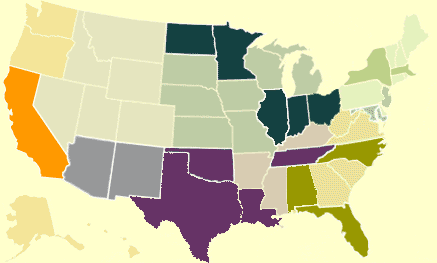
Congratulations to the 31 States (and D.C.) that were awarded Money Follow the Person grants. Those States have agreed to transition nearly 27,000 persons from nursing homes to the community. For each of those 27,000 persons, the federal government will reimburse these States at an "enhanced" federal Medicaid (MA) match.

That's right. Those States will receive more federal MA funds, and therefore spend less of States' funds, to move 27,000 persons into the community. Sound like a win/win/win: your State saves money, the Feds spend less MA funds in the community than in nursing homes, and people live with their family and friends in the community.

Then why would States not apply for enhanced federal MFP funds when a State could save its money? Let's look at those States that did not apply or were rejected. Keep in mind that the federal agency, CMS, did not allocate all of the $1.5 Billion Congress authorized, and we believe CMS really wanted to allocate all of the money.

Three States applied and were rejected by CMS - Mississippi, Rhode Island and Tennessee. We're not sure why CMS rejected these three applications. Advocates in these States should send a Freedom of Information Act request to CMS and ask for both the application from your state and all CMS correspondence that resulted in a rejection. [A FOIA request is a simple letter telling CMS that you want the information and that the request is pursuant to FOIA.] You should make sure your State really tried to receive a MFP grant and did not submit an inadequate application only to placate the disability community. We wonder if these three did not agree to "rebalance" their MA budgets to make them less biased in favor of the nursing home institutions. If that is the reason, older American and disability advocates should know.

Four States, Florida, Idaho, West Virginia and New Mexico, initially applied for a MFP grant in the first tier of applications, were rejected (as were many States) and then did not reapply for the second tier MFP awards. Advocates in these four States should send a Freedom of Information Act request to CMS and ask for both the application from your state and all CMS correspondence that resulted in the rejection. You should then ask your State officials why they did not bother to reapply for the second tier. We're curious if disability and older American advocates participated in the decision not to reapply. Many States had to file two applications and overwhelmingly they were awarded MFP grants in the second tier.

These remaining thirteen States which never applied for free federal MA reimbursements, as well as the four that did not apply for the second tier, should be asked some questions. Here are some preliminary ideas the disability and older American advocates in those seventeen States might want to consider.

First, we have heard some excuses from a few States for not applying, but we'd like to hear the reasons from all of these 17. If disability and older American advocates tried to have your State apply and it refused, please forward the reasons. If your State put the reason in writing, fax it to us (215-627-3183). If you don't know why, ask them.

Second, is there any discussion in your State of starting an "underground railroad" with Harriet Tubman to move persons with disabilities out of nursing homes, despite your State's refusal to apply for "enhanced" federal funds? Are there any Harriets when we desperately need them?
Third, we know there are advocates and persons in the nursing homes in these States who have read and understand the Olmstead decision and want to implement it in their States? What help do the advocates need to "free people" from unnecessary institutionalization?

We'd really like to know if there is anything that can be done to help you. What can older American and disability advocates in other States do to help you? Do you need technical training? Lawyers? What? Please let us know.

Fourth, do these seventeen States have "waiting lists" for home and community-based services or for waiver services, or can every person, who needs and requests community-based services, receive them? What about those persons listed below who are in nursing homes and who have stated, as of 3/31/07, that they want to reside in the community? Why aren't they currently receiving the HCBS services and moving back to their communities?

Listed below are all 20 States discussed above: the seventeen States that did not apply for either MFP match or did not apply for the second-tier enhanced federal match, and the three States that were rejected. Next to each State, we list the number of persons in the nursing homes who stated, according to the 3/07 MDS, Q1a data, they want to move to and reside in the community and not stay in the nursing home:


STATE

people in nursing homes want to live in the community

STATE

people in nursing homes want to

 live in the community

Alabama

3,651

Montana

1,307

Alaska

172

Nevada

1,344

Arizona

3,188

New Mexico

1,675 [has a state MFP program]

Colorado

3,741

Rhode Island

1,546

Florida

19,206

South Dakota

1,053

Idaho

1,156

Tennessee

7,068

Maine

1,550

Utah

1,776

Massachusetts

8,982

Vermont

711

Minnesota

6,519

West Virginia
 

1,965

Mississippi

1,737

Wyoming
 

537

Steve Gold, The Disability Odyssey continues

MFP and Persons with MR/DD and MI. Information Bulletin #211 (5/07)


Less we forget or ignore them, many of the recent 31 states that were awarded Money Follows the Person grants received enhanced federal financial assistance for more than older Americans and people with physical disabilities in nursing homes who want to reside in the community.

Nearly 7,500 persons with MR/DD who presumably reside in ICFs and/or State Centers will also be transitioned to the community, and nearly 2,300 persons with MI will be moved to the community. These people represent nearly 26% of the total number of people with disabilities who will, as a result of the MFP awards, be freed from the unnecessary institutionalization.

CMS stuck to its word that it wanted applications to reflect multiple disabilities.

Now, "wouldn't it be loverly" if this were a step in reducing, dare we say eliminating, the silo mentality that pervades the disability community. Could this be a small step in truly making the ADA a real ADA and not an AMIA, an AMR/DDA, or an APDA?

If your State is not listed, it means your State either did not apply for the enhanced federal MA match funds or it was rejected. In either case, your State's failure could be a great opportunity for "D" advocates of all Ds, and older Americans, to join together to hold your States accountable.
There are lots of people unnecessarily institutionalized in your State!

Here is a list of the 31 States (and DC) with the number of persons with MR/DD and the number of persons with MI who will be transitioned to the community with enhanced federal MA match funds.
 

STATE

 People with MR/DD

People with MI

STATE

 People with MR/DD

People with MI

Arkansas

60

7

Nebraska

200

0

California

 331

185

New Hampshire

0

0

Connecticut

140

140

New Jersey

329

0

Delaware

20

20

New York

140

280

D. C.

 150

100

North Carolina

172

42

Georgia

562

35

North Dakota

30

0

Hawaii

58

0

Ohio

584

61

Illinois

105

735

Oklahoma

225

0

Indiana

71

0

Oregon

179

0

Iowa

 528

0

Pennsylvania

420

180

Kansas

286

0

South Carolina

0

0

Kentucky

216

0

Texas

1216

160

Louisiana

320

0

Virginia

358

0

Maryland

250

75

Washington

80

60

Michigan

0

0

Wisconsin

337

202

Missouri

50

0


Steve Gold, The Disability Odyssey continues

Back issues of other Information Bulletins are available online at http://www.stevegoldada.com with a searchable Archive at this site divided into different subjects. To contact Steve Gold directly, write to stevegoldada@cs.com  or call 215-627-7100.

'Workers with Disabilities: Talent for a Winning Team!' is 2007 National Disability Employment Awareness Month theme


http://www.dol.gov/opa/media/press/odep/odep20070555.htm


WASHINGTON - U.S. Secretary of Labor Elaine L. Chao today announced that "Workers with Disabilities: Talent for a Winning Team!" will be the official 2007 theme for National Disability Employment Awareness Month, which is observed in October nationwide.

"The 2007 'Talent for a Winning Team' theme captures the heart of the president's New Freedom Initiative, which is that Americans with disabilities are an underutilized reservoir of ambition, talent and skill ready to make great contributions in the workplace," said Secretary Chao.

Each October is National Disability Employment Awareness Month by congressional designation. The Labor Department's Office of Disability Employment Policy (ODEP) leads the nation's activities and produces materials to increase the public's awareness of the contributions and skills of American workers with disabilities. Typically, private sector; federal, state and local government; and advocacy organizations piggyback on the same theme to plan events and programs that showcase the abilities of employees and job candidates with disabilities.

"America's employers benefit when they provide opportunities for Americans with disabilities to work," said Roy Grizzard, assistant secretary of labor for ODEP. "A winning team will include people with disabilities."
 

Check Out the New RIOT Website!


Please take a look at our new website!  We hope that you like it.  It has a sharper look and is easier to use.  Go to:  www.theriotrocks.org

On the site, you can easily find your way around.  Look at the current issue of The Riot!  Find old issues.  Write Cubby for love advice.  Get a Riot! t-shirt.  Help us out with a donation.  Send us your ideas or comments. Check it out!  It's a regular Riot! Go to:  www.theriotrocks.org

Send this link to your friends.  Tell them that they can sign up for free to get The Riot! The next issue of The Riot! will be ready in July 2007.  We will send you an email when it's ready to see on the website.

The Riot Staff 


Brand New Accessibility Coalition Scores Gains in Phone Services


Coalition of Organizations for Accessible Technology (COAT) Applauds FCC's New Disability Accessibility Requirements

Washington, D.C. - Today, the Federal Communications Commission (FCC) adopted a Report and Order, "Disability Access Requirements Extended To VoIP Services" at its monthly open meeting. The FCC Order levels the playing field so that interconnected Voice Over Internet Protocol (VoIP) service providers must meet similar requirements for providing access to people with disabilities that wireline and wireless providers currently meet.

"We applaud this significant step forward in making sure persons disabilities will not be left behind or left out of the next generation of phone services using Internet technologies," says Jenifer Simpson, of the American Association of People with Disabilities (AAPD), a cofounder and spokesperson for the Coalition.

The Order does three things for persons with disabilities. It extends the accessibility and usability requirements of Section 255 of the Communications Act to VoIP service providers. It requires VoIP providers to contribute into the Interstate Telecommunications Relay Services(TRS) Fund. It also requires VoIP service providers to meet the same TRS obligations that traditional phone companies must meet, such as connecting relay service users via 711, the nation's free access number to reach a relay service center.

"Companies using new phone technologies should make their products and services accessible and usable for people with vision loss. Why should I have to ask someone to place a phone call for me just because some company forgot to design phone services with my needs in mind?" asks Mark Richert of the American Foundation for the Blind (AFB), another co-founder of the disability coalition supporting the FCC action. "And, if we can't get our telephone bills in Braille, how do they expect us to pay them?"

"New contributors into the relay services fund are important because the number of traditional phone customers is continuing to decline," explains Karen Peltz Strauss of Communication Service for the Deaf (CSD, Inc.), also a founder of the new disability coalition. "Relay services are absolutely essential for people with hearing and speech disabilities."

"The 1996 Telecommunications Act required phone companies and manufacturers to make services and products disability accessibility and usable," adds Jenifer Simpson. "Here we are, eleven years later and some companies still forget to design at the front end for the needs of people with all kinds of disabilities, leaving them behind as the rest of the population gets to use all kinds of new and exciting communication technologies. Everyone's getting pretty fed up with not being able to use these innovative gadgets and services. This FCC action is a good step forward, but it's time for the whole communications industry to take a giant step forward. We want to see accessibility in all products and services in the marketplace."

COAT is a new coalition of disability organizations, launched in March 2007, to advocate for legislative and regulatory safeguards that will ensure full access by people with disabilities to evolving high speed broadband, wireless and other Internet protocol (IP) technologies. The Coalition of Organizations for Accessible Technology, or COAT, consists of over 67 national, regional, and community-based organizations dedicated to making  sure that as our nation migrates from legacy public switched-based telecommunications to more versatile and innovative IP-based and other communication technologies, people with disabilities will benefit like everyone else. More information about the disability coalition is available at website http://www.coataccess.org

SOURCE: AAPD
 

One-Stop Toolkit Resources of the Week Technical Assistance Project
Youth Transitions Initiative


http://www.hscfoundation.org/whatwedo/youthtransitionsinitiative.php

The HSC Foundation is dedicated to improving access to services for individuals who face challenging social and health care barriers due to disability, chronic illness, or other circumstances that present unique needs.  The HSC Foundation has launched a new Youth Transitions Initiative, designed to become a long-range signature project to assist young people with disabilities and chronic illness in the Washington metropolitan area and beyond to move from school to adulthood to the world of work.


The aim is for the Initiative to become a central resource in the field of youth transitions, filling gaps in information and providing support for organizations that are involved in transitioning youth. The Foundation’s approach to transition is intended to be comprehensive, and as such, includes health, education, vocational training, youth development, employment, and social components. The Initiative's ultimate goal is to strengthen transition programs and services and stimulate other investments in the field.


Solutions:  Call for Articles


SOLUTIONS is an online newsletter published by Hire Disability Solutions.  Each issue features articles about the employment of individuals with disabilities.  The primary purpose of the publication is to provide information to the Hire Disability Solutions community that will help increase understanding and awareness of disability related issues and help facilitate employment.  The Hire Disability Solutions community consists of corporations who have a commitment to helping individuals with disabilities succeed, individuals with disabilities seeking employment, and others who believe in the Hire Disability Solutions' mission of "Giving all that want to succeed, the opportunity to succeed".  SOLUTIONS is primarily distributed electronically to individuals who have signed up to receive it, but each issue is available on HireDS.com  for individuals who register.  Printed copies are also available upon request.


For the Summer Edition, SOLUTIONS is looking to highlight employer diversity programs that include people with disabilities.  They would like to hear from employers who have diversity policies, and how they include people with disabilities, individuals who have benefited from diversity programs, co-workers of people with disabilities, and service providers.  If you would like to contribute an article, send an article proposal. The proposal should include a working title and a couple of paragraphs describing what the article will discuss. SOLUTIONS will then send you a copy of their "Article Specifications" describing how your article should be formatted.  Once SOLUTIONS has received all contributions for a specific issue, the issue editor will choose articles for the current publication.  Articles that are not chosen for the current publication may be published at a later date. The topic for the next issue will be announced once the preceding issue has been prepared and released.  The Hire Disability Solutions' community will influence the issue's topics.


 Please send all article proposals and questions about SOLUTIONS to Jeff Klare at jklare@hireDS.com.


Regular mail: Hire Disability Solutions, 74-20th Street, Brooklyn, NY 11232, Attn: Jeff Klare


Hire Disability Solutions was founded in response to the increasing demand for services for individuals with disabilities that promote inclusion into the mainstream employment world. Since its inception in 2004, Hire Disability Solutions has established itself as a national leader in protecting and enhancing employment opportunities for individuals with disabilities.  Through its educational campaigns surrounding employment law, education opportunities and assistive technology, the company facilitates the success of individuals with disabilities and employers alike.   


The New Freedom Transportation Program: An Introduction


http://projectaction.easterseals.com/site/PageServer?pagename=ESPA_technical_assistance_NFP_Intro_Q_and_A&autologin=true


This Q&A is intended to provide a general overview of the New Freedom transportation program contained in SAFETEA-LU.  This funding program supports accessible transportation programs and facilities that meet specific criteria. The succinct four-page document presents the information in a question-and-answer format and touches on eligibility, funding allocation, match requirement, coordinated planning and other useful highlights plus advice for being involved in implementation.  For details and full guidance on the program, readers are urged to read Federal Transit Administration circular 9045.1, "New Freedom Program Guidance and Application Instructions" (effective May 1, 2007) which can be downloaded through the FTA Web site at: http://www.fta.dot.gov/laws/circulars/leg_reg_6624.html.


Transportation Coordination Planning Tools


Community Transportation Association of America

The transportation coordination planning process may seem difficult or overwhelming to those community members involved, but it doesn't have to be.  In fact, there are a number of planning resources on the web that can provide direction in the process.  The following are a few recent additions to the CTAA web library of freely available coordination planning materials.


Transit Coordination Toolkit (http://www.cts.umn.edu/ct/coordination/toolkit/index.html) The University of Minnesota Center for Transportation Studies has assembled a series of briefs on popular issues that arise in the planning process.  The issues vary from Private/Public Sector Partnerships to Maintenance Programs, and each section provides definitions, useful practices, and resources for further information.


Coordinated Plan Toolkit (http://www2.ku.edu/cgiwrap/kutc/cpt/index.php The Kansas University Transportation Center put together this toolkit that describes coordination planning as a five-step process that guides a planning agency from Identifying Stakeholders to Implementing the Plan.


Coordination Plans Web page (http://www.ctaa.org/ntrc/coordination/plans.asp)  It can be beneficial to examine the coordination plans of other regions when formulating a plan, and the CTAA Information Station library maintains a large and growing collection of local coordination plans that can serve as examples for those in the midst of the planning process.  If you know of a plan that is not yet in our library, please let us know by e-mailing frankland@ctaa.org.


The Future of Disability Statistics: What we Know and Need to Know


Materials from the 2006 StatsRRTC State-of-the-Science Conference - http://www.ilr.cornell.edu/edi/p-srrtc-2006conference.cfm#1

Materials from the 2006 StatsRRTC State-of-the-Science Conference. Includes trends and statistics on the employment, health and socio-economic status of people with disabilities.


REMINDER:  Workforce Innovations 2007


Where Will You Be on July 17-19, 2007?
Join Your Colleagues at Workforce Innovations 2007!

www.workforceinnovations.org (conference)

https://www.ambassadorstechnology.com/workforce/2007/event/index2.cfm%20 (registration)

http://www.ambassadorstechnology.com/housing/fwd/wic07 (hotel)


Join more than 3000 of your colleagues from across the country to attend Workforce Innovations 2007, July 17-19, 2007 at the Kansas City (MO) Convention Center. Workforce Innovations is the premier annual conference for local, state, and national workforce, business, economic development, and education leaders, providing an opportunity to share common experiences and challenges in building a highly skilled and adaptable workforce.


This year's theme, Beyond Boundaries, will explore ways in which key partners can collaborate and innovate to break down historical, geographical, political, or financial boundaries to create a competitive workforce advantage that meets the demands of the 21st century marketplace. You will want to be part of the experience!


Workforce Innovations 2007 offers:

  • Great sessions on workforce issues, economic competitiveness, systems transformation, and talent development - whether you're new to these issues or are ready for more advanced discussions

  • Ample opportunity for networking and dialogue about issues important to you with thousands of colleagues from across the country

  • Provocative plenary and town hall meeting speakers

  • More "how-to" sessions

  • Engaging pre-conference activities  

Take one - or all - of our three conference pathways: Whether you're involved in regional economic competitiveness, workforce system transformation, or lifelong talent development you will come away energized and equipped with the tools and strategies you need to succeed. Workforce Innovations - a catalyst for innovative thinking and creativity!


Check out the conference Web site regularly at www.WorkforceInnovations.org for updated information on the conference program, pre-conference sessions, educational tours, and more. And if you haven't been to Kansas City recently, check out the dozens of new Kansas City developments http://www.visitkc.com/.


Co-sponsored By: U.S. Department of Labor http://www.dol.gov/, Employment & Training Administration http://www.doleta.gov/,

American Society for Training & Development http://www.astd.org/


Workplace Technologies for People with Disabilities


A Guide for People with Disabilities, Businesses, & Vocational Service Professionals
Illinois Assistive Technology Program

http://www.iltech.org/workplace%20technologies.pdf

[Originally published in 2002 with most recent revision June 2005.]
Employment focused guide on how employers and service providers can utilize assistive technology to make workplaces and service centers accessible to people with disabilities. Contains illustrations of many different types of assistive technologies including descriptive text on the use of these technologies. Document is in .PDF format. 


GAO Report of Interest:  Vocational Rehabilitation:  Improved Information and Practices May Enhance State Agency Earnings Outcomes for SSA Beneficiaries


GAO-07-521, May 23, 2007 http://www.gao.gov/cgi-bin/getrpt?GAO-07-521 (highlights) http://www.gao.gov/highlights/d07521high.pdf

State vocational rehabilitation (VR) agencies, under the Department of Education (Education), play a crucial role in helping individuals with disabilities prepare for and obtain employment, including individuals receiving disability benefits from the Social Security Administration (SSA). In a prior report (GAO-05-865), GAO found that state VR agencies varied in the rates of employment achieved for SSA beneficiaries. To help understand this variation, this report analyzed SSA and Education data and surveyed state agencies to determine the extent to which (1) agencies varied in earnings outcomes over time; (2) differences in state economic conditions, client demographic traits, and agency strategies could account for agency performance; and (3) Education's data could be used to identify factors that account for differences in individual earnings outcomes.


GAO recommends that Education promote certain promising practices identified in its analysis, reassess the data it collects on clients, and consider economic factors when measuring state agency performance. Education generally agreed with GAO's recommendations, but disagreed that economic factors should be incorporated into performance measures. It considers these factors during monitoring and believes its approach to be effective. GAO maintains that these factors are critical to measuring agencies' relative performance.


Until Next week


The Arc of the United States, 1010 Wayne Avenue, Ste. 650, Silver Spring, MD 20910, Phone: 301-565-3842, Fax: 301-565-3843, Email: mmwdc@info.thearc.org, Web: www.thearc.org


Disclaimer: MMWDC publishes information about issues and events that we believe to be important and likely to be of interest to advocates and others interested in inclusion of persons with disabilities in all parts of society.  However, MMWDC and The Arc of the United States do not necessarily endorse all events, sponsoring organizations and reports which appear.