| Volume 08 | Issue 25 | June 23, 2008 |
Welcome to Monday Morning in Washington, D.C., published weekly by The Arc of the United States. We will bring to you news of interest to self advocates and their families, volunteers, professionals, and supporters of the disability movement. Please send any comments to mmwdc@thearc.org. You are welcome to reproduce and distribute items from Monday Morning in Washington, D.C., but please credit Monday Morning in Washington, D.C. (The Arc of the United States, 2007).
The Arc of the United States advocates for the rights and full participation of all children and adults with intellectual and developmental disabilities. Together with our network of members and affiliated chapters, we improve systems of supports and services; connect families; inspire communities; and influence public policy.
[NOTE: Having trouble reading this newsletter? Read it online.] [Past Issues]
Historic event on the 18th ADA anniversary!
July 26, 2008. Write it down. Not only is it the date of the 18th anniversary of the signing of our civil rights law, the Americans with Disabilities Act (ADA), it's also the date set for a historic, nonpartisan, cross-disability forum on national disability policy, featuring the 2008 presidential candidates (invited) in Columbus, Ohio.
With over 60 national, state, and local disability-related organizations and moderated by news anchor and journalist Judy Woodruff ("The News Hour with Jim Lehrer," PBS), this event promises to be THE disability event of this election cycle Register for the 2008 Presidential Forum -
http://www.govoter.org/presidential_forum
About the Forum
The National Forum on Disability Issues, featuring the 2008 Presidential Candidates (invited) is a historic, nonpartisan forum on national disability policy to be held on July 26, 2008 in Columbus, Ohio. The venue allows us to welcome well over a thousand Americans with disabilities and their friends and family (registration required) to attend the event, and to commemorate the 18th anniversary of our civil rights law, the Americans with Disabilities Act. The forum will feature time slots for the presidential candidates to individually present their visions for the future of disability policy in America followed by questions by Judy Woodruff, news anchor and journalist ("The News Hour with Jim Lehrer"), who will act as the Moderator.
This event will be webcast. Information to be made available at www.aapd.com -
www.govoter.org/presidential_forum
Attending the Forum
Date: Saturday, July 26, 2008
Time: 12:30 pm ET - 3:30 pm ET
Location:
Conference & Technology Center,
First Church of God,
3480 Refugee Road,
Columbus, Ohio 43232
WHEN: Start today! The forum isn't until July 26, and we need daily, everyday pressure on the campaigns all the way until the event or until the candidates say they'll participate in the forum.
WHAT TO DO: Call, fax, email the campaigns. Help us to create some friendly pressure on the McCain and Obama campaigns by calling, emailing, and faxing the campaign offices, urging the candidates to participate in person at The National Forum on Disability Issues on July 26, 2008 in Columbus, Ohio.
Sen. Barack Obama
National Headquarters:
Obama for America P.O. Box 8102 Chicago, IL 60680
Call: (866) 675-2008 Fax: (312) 819-2089
(Obama's Ohio office will open later this summer)
Sen. John McCain
National Headquarters: John McCain 2008 P.O. Box 16118 Arlington, VA 22215
Call: (703) 418-2008 Faxes: (703) 752-2515, (703) 414-0740
Ohio Offices: John McCain 2008 Ohio Regional Headquarters
240 North Fifth Street, Suite 340 Columbus, OH 43215
Call: (614) 441-8097 Fax: (614) 222-2530
REPORT BACK: Let us know what you hear! Send your progress reports or any updates to the Moderator of the Justice for All national disability email listserv at JFAModerator@aol.com and use the subject line: "Ohio presidential forum."
Steve Gold, The Disability Odyssey continues
Happy Ninth Anniversary - Olmstead. Information Bulletin #261 (6/08).
June 22, 1999 - The U.S. Supreme Court issued the Olmstead decision,
holding that "unjustified institutional isolation of persons with
disabilities is a form of discrimination." The Court rejected the State's
argument that Medicaid statute reflected a congressional preference for "treatment in the institution over treatment in the community," pointing
out that was not correct since 1981 when Medicaid provided for home and
community-based services and the U.S. Department of Health and Human
Services has had a "policy of encouraging" States to serve people with
disabilities in the community.
The decision recognized that the ending of this discrimination would not
occur immediately. In 1999, the Court permitted States to have "waiting
lists" for community services as long as such lists "moved at a
reasonable pace not controlled by the State's endeavors to keep its
institutions fully populated."
For people with disabilities, this decision was a clarion call. No
longer, the disability and elderly advocates believed, would people be
institutionalized if they wanted to reside in the community. Obviously,
where one resides should be one's own choice.
We all know, however, that the availability and allocation of funds
frequently determines the "choice." Specifically, if you are on
Supplemental Security Income, and/or your only source of income is either
only Social Security Disability Income or Social Security Retirement, your "choice" may be limited to where your State spends its Medicaid funds - in
nursing homes or in the community.
AARP surveys point out that more than 90% of older Americans do not want
to reside in nursing homes, and according to the Minimum Data Set reports,
the national percentages of people in nursing homes who want to live in
the community continues to increase steadily year by year (2003 -18.7%,
2004 -19.9%, 2005 - 20.5%, 2006- 21.4%, 2007 - 22.0%, and 2008
22.8%)(check out your state http://www.cms.hhs.gov/MDSPubQIandResRep/ click on MDS Activity Report and then Q1a).
To see the full report and how how your state is doing: www.stevegoldada.com/stevegoldada/archive.php?mode=A&id=251;&sort=D
Good-Bye Full Accessibility - Information Bulletin #250 (6/08)
In 1990, the disability community, Congress, state officials and
businesses made numerous compromises to obtain the passage of the ADA.
Despite these compromises, then President Bush, disability leaders and
Congress trumpeted the eventual full accessibility of public and private
facilities. Sometime in the future, people with disabilities would achieve
equal opportunity with nondisabled and full accessibility would be
achieved.
Since 1990, we have seen some progress - curb cuts are now more the norm;
ramps provide access to some stores and businesses (definitely not in
everyone); some public swimming pools, playgrounds, and governmental
buildings provide a degree of accessibility (often begrudgingly); sports
venues are more accessible.
However, by and large, neither the governmental entities (Title II of the
ADA), nor private business entities(aka public accommodations) (Title III
of the ADA) have taken the initiative on their own and said "oh, Congress
has made disability a civil right, and we will do the right thing and make
our facilities and programs accessible."
Rather, progress has been slow, often requiring disability advocates to
take the initiative and demand governmental and business entities to
comply with the 1990 law and not make more compromises. The process is
slow because disability advocates may not exist in a community, or they
get frustrated that change is difficult.
On June 17, 2008, the Department of Justice issued proposed rules to the
ADA's federal regulations which, if adopted, will significantly undercut
the original 1990 compromises and will impose numerous regressive
restrictions. Many of the proposed rules will ensure that full
accessibility will be, at best, postponed indefinitely.
To read the full report go to: http://www.stevegoldada.com/stevegoldada/archive.php?mode=A&id=250;&sort=D
Back issues of other Information Bulletins are available online at
http://www.stevegoldada.com
with a searchable Archive at this site divided into different subjects. To contact Steve Gold directly, write to stevegoldada@cs.com or call
215-627-7100.
Institute on Disability (NH UCEDD) to Feature Autism National Committee Bookstore at Autism Summer Institute
www.iod.unh.edu
The IOD Bookstore features publications, information, and merchandise
focused on strengthening communities and ensuring full access,
participation, and equal opportunity for all persons. The AutCom
Bookstore specializes in books that have been carefully selected to
reflect the social justice and humanitarian values of the Autism
National Committee and is a premier source for books that have been
written by individuals who experience autism. Information from the
Asperger's Association of New England, Autism Society of New Hampshire,
and other collaborative partners will also be available as a resource
for all participants. The IOD and Autism National Committee (AutCom)
Bookstore will be available to participants of this year's Autism Summer
Institute on August 11-14, 2008 at UNH Holloway Commons in Durham, NH.
A complete listing of IOD and AutCom Bookstore merchandise can be found
online at http://iodserver.unh.edu/iodbookstore/
Institute for Disability Studies (MS UCEDD) Staff Member
Appointed to Advisory Council of the Federal Home Loan Bank of Dallas
Cassie Hicks, coordinator of housing initiatives for The University of
Southern Mississippi Institute for Disability Studies, has been
appointed to the 2008 Advisory Council of the Federal Home Loan Bank of
Dallas. Wholly owned by member financial institutions in Arkansas, Louisiana, Mississippi, New Mexico and Texas, the bank does not lend
directly to the public, but provides low-cost funds to its member
institutions. The bank's primary goal is to help members fund housing
small business, small agri-business and economic and community
development loans in their communities.
The Journal for Disability and International Development
Deadline: September 1, 2008
Topic: Situation of Persons with Disabilities in Post-War and
Post-Conflict Situations. This issue of the journal deals with living
conditions and situations of people with disabilities after periods of
war and/or conflict. As already stated by UN Special Rapporteur Leandro
Despouy, in 1993 wars and armed conflicts are causing long-term
disabilities in large groups of the population and - at the same time -
are situations of high vulnerability for PWD. Since strategies of war as
well as weapons have changed over the last decades and differ from
conflict to conflict, the situation of PWD afterwards might be disparate
but disastrous in any way. The challenges that arise are manifold for
PWD as well as aid organisations and governments. In most situations of
conflict victims have no legal basis to claim their rights. At the same
time they have to cope with insufficient rehabilitation services. With
this issue, the German Journal for Disability and International
Development wants to raise a topic that is not often heard but reality
for many people. For more information, contact: Gabriele Weigt
gabi.weigt@t-online.de or Doris Graeber doris.graeber@arcor.de.
Chief Executive Officer
National Association of Councils on Developmental Disabilities,
Alexandria, VA
http://www.aucd.org/template/opportunity.cfm?opportunity_id=216&id=158&parent=158
The National Association of Councils on Developmental Disabilities
(NACDD) is a member-driven 501(c)(3) nonprofit organization consisting
of 55 state and territorial Councils. NACDD represents the diverse
interests of the Councils and serves as their national voice. NACDD's
purpose is to support the Councils: (1) in their role of implementing
the Developmental Disabilities Assistance and Bill of Rights Act, (2) in
their role in promoting the interests and rights of people with
developmental disabilities and their families, and (3) in their role as
change agents working towards positive systemic change on behalf of
persons with developmental disabilities. Salary will be competitive and
commensurate with experience. NACDD offers a competitive salary and
benefits package that is comparable to other associations with similar
size and budget. To apply, please email cover letter, resume, and
salary requirements to: NACDD@transitionguides.com. For a copy of the
full position profile, please visit:
www.transitionguides.com/jobs/NACDD.htm.
Health Implications of Caregiving
Centers for Medicare & Medicaid Services and the Department of Health
and Human Services New Freedom Initiative Subcommittee on Caregiving
June 25, 2008, 1-2:30 PM (Eastern Time)http://www.blsmeetings.net/caregivers/
This satellite broadcast will provide viewers information on how
caregiving impacts the health and well-being of the caregivers
themselves. It will provide tips on self-care, approaches taken by
several organizations to support family caregivers, and innovative
programs that help caregivers take care of their own health. This
program is geared towards those in the community who help caregivers
identify and utilize resources that help them preserve and improve their
own health including case managers, social workers, employers, health
care providers and those in the aging network.
National Conference Disability Inclusion & National Service:
Acting Today to Shape the Future
October 16-18, 2008; Hilton Alexandria Mark Center, Alexandria, VA
This event invites the national service and disability communities to
convene in a setting that fosters the development of innovative ideas
and strong partnerships. With opportunities for learning, reflection and
celebration, this conference will inspire current and tomorrow's leaders
to direct the future shape of disability inclusion in national service
and enhance the ethic of service and volunteerism in the disability
community. For information regarding registration, becoming an
exhibitor or workshop presenter, visit:
http://www.serviceandinclusion.org
Save-the-Date: 2008 Global Summit on Education for All: Inclusive
Practices for Students with Disabilities
September 19-20, 2008; Washington, D.C.
U.S. Secretary of Education Margaret Spellings is sponsoring and hosting
the 2008 Global Summit on Education for All: Inclusive Practices for
Students with Disabilities and is inviting educational leaders,
disability advocates, educators, academics, government officials and
students from countries around the world to:
The intended audience for this conference includes researchers,
policymakers, government leaders, students and families.
For more information: Melissa Storm with the American Institute for
Research (AIR), Washington, DC; mstorm@air.org - phone number is
+(202)403-5363.
Entrepreneur Creates Workplace for the Disabled
June 18, 2008, The Washington Post
http://blog.washingtonpost.com/small-business/2008/06/entrepreneur_creates_workplace.html
TecAccess, a firm offering IT consulting and training to corporations as
well as government and educational institutions, that today has about 60
full-time and contracted employees, most of whom have developmental or
physical disabilities ranging from bipolar disorder, blindness, brain
injury or cerebral palsy to quadriplegia.
United Cerebral Palsy Releases Annual State Medicaid Rankings
June 16, 2008; SunHerald
http://www.sunherald.com/prnewswire/story/628035.html
WASHINGTON, June 16 --
United Cerebral Palsy (UCP) reported today that people with intellectual
and developmental disabilities being served by Medicaid are not getting
the community-based supports they need in every State. The report, The
Case for Inclusion 2008, ranks all 50 States and the District of
Columbia. At the top of the list: (1) Arizona, (2) Vermont, (3) Alaska,
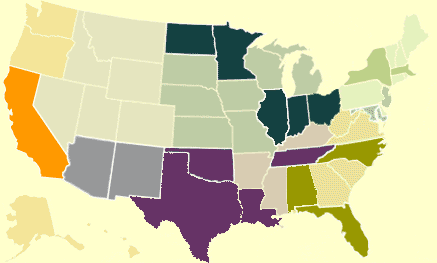
(4) Massachusetts, and (5) California. At the bottom: (51) Mississippi,
(50) Texas, (49) Illinois, (48) District of Columbia, and (47) Virginia.
The full report may be accessed at http://www.ucp.org/medicaid/
Caregivers' pay at heart of lawsuit
June 13, 2008; Statesmanjournal.com
http://www.statesmanjournal.com/apps/pbcs.dll/article?AID=2008806130339
Paralyzed since he broke his neck in a 1996 diving accident, Clay
Freeman depends on 11 machines and around-the-clock care to stay alive.
The federal civil-rights lawsuit asks that the state be required to
provide enhanced caregiver compensation so that Freeman can hire the
help he must have to deal with his daunting disabilities.
is a national and state-by-state profile of the well-being of America’s children that ranks states on 10 key measures and provides data on the economic, health, education, and social conditions of America’s children and families. It is now available online at http://www.kidscount.org/datacenter/databook.jsp
The National Head Start Association's HeadsUp! Training Network
The HeadsUp! Network is a subscriber training service operated by the National Head Start Association. The network uses satellite television to deliver workshops, the latest research, and 10-12 hours of training each month to thousands Head Start and early childhood educators. This month HeadsUp will air the following two programs produced by the Center on the Social and Emotional Foundations for Early Learning (CSEFEL) and the Technical Assistance Center on Social Emotional Intervention for Young Children (TACSEI): June 17, 2008 - Practical Strategies for Teaching Social Emotional; Skills (31 min.) June 24, 2008 - Promoting Social Emotional Competence (22 min.) For more information on the HeadsUp! Training Network go to http://www.heads-up.org/
The National Medical Home Autism Initiative
The National Medical Home Autism Initiative has released the final copy of the Service System Guidelines for Medical Home Primary Care Practices. These guidelines were drafted by an ASD Service Guideline Workgroup (comprised of many COCWD members) that was formed by the Maternal and Child Health Bureau in 2007. They were then presented for review and comment to several professional, administrative and family advocacy organizations. The guidelines present a framework for ASD services within the Medical Home and offer a series of system guidelines to promote discussion, interaction and collaboration among key stakeholders. You may find the document to be a useful reference as you address autism related issues in your state. Copies can be downloaded from the Waisman Center website at: http://www.waisman.wisc.edu/cedd/NMHAI/publications.phpDental Care: The Often Neglected Part of Health Care
Dental Care: The Often Neglected Part of Health Care-Research shows that school-based oral health programs can reduce tooth decay and promote oral health education -- and do so cost-effectively, according to a new brief from Schools of the 21st Century at Yale University. http://www.yale.edu/21c/publications.html
Prevalence of Developmental Delays and Participation in Early Intervention Services for Young Children-
http://pediatrics.aappublications.org/cgi/content/full/121/6/e1503
The Patient Advocate Foundation:
Patient Advocate Foundation is a national non-profit organization that seeks to safeguard patients through effective mediation assuring access to care, maintenance of employment and preservation of their financial stability relative to their diagnosis of life threatening or debilitating diseases. http://www.patientadvocate.org/index.php
Family Voices
Friday's Child: June 6, 2008
You can download a print version of this newsletter at http://www.familyvoices.org/pub/fc/FC_2008-06-06.pdf.
Georgetown University’s Health Policy Institute - Center for Children and FamilyThe Office of Minority Health provides information, referral, and advocacy related to health care issues of racial and ethnic minorities.
Their goal is to improve health outcomes and reduce health care disparity within these communities. http://www.omhrc.gov/templates/browse.aspx?lvl=1&lvlID=7
DisabilityInfo.gov
Health News & Events Update: HHS Takes Action to Help Medicare Beneficiaries and Providers in Iowa and Indiana
Because of flood damage to local health care facilities, many beneficiaries have been evacuated to neighboring communities where receiving hospitals and nursing homes may have no health care records or verification of a person's status as a Medicare beneficiary. The Centers for Medicare & Medicaid Services (CMS) is waiving the normal documentation requirements so facilities can presume eligibility. Read the complete news release for other actions HHS Secretary Mike Leavitt took today in declaring a public health emergency in the flood-stricken states of Iowa and Indiana. This information has recently been updated, and can be accessed by visiting this link: http://www.disabilityinfo.gov/digov-public/public/DisplayPage.do?parentFolderId=138.
DisabilityInfo.gov
Americans with Disabilities Act Employment Laws & Regulations Update: Definition of Disability Under the Americans with Disabilities Act (ADA)
Several recently added resources on how the ADA relates to certain employment issues, including the definition of disability under the ADA, injured workers and the ADA and leave rights under the FMLA and ADA. This information has recently been can be accessed by visiting this link: http://www.disabilityinfo.gov/digov-public/public/DisplayPage.do?parentFolderId=5086.
DisabilityInfo.gov
Grants & Funding in Technology Update: Two New Technology Access Funding Opportunities
Information on two new funding opportunities from the U.S. Department of Education: Technology Access in Resource-Limited Environments and Universal Interface & Information Technology Access.
You are subscribed to Grants & Funding in Technology for DisabilityInfo.gov. This information has recently been updated, and can be accessed by visiting this link: http://www.disabilityinfo.gov/digov-public/public/DisplayPage.do?parentFolderId=5106.
DisabilityInfo.gov
Civil Rights News & Events Update: DOJ Seeks Public Comment on Proposed Changes to Regulations Implementing the ADA
The Department of Justice (DOJ) is seeking public comment on proposed changes to its regulations implementing Titles II and III of the Americans with Disabilities Act of 1990 (ADA). The proposed regulations will establish specific requirements for the design of accessible public facilities such as courtrooms and an array of recreational facilities including playgrounds, swimming pools, amusement parks and golf courses, making it easier for individuals with disabilities to enjoy leisure activities and otherwise participate in society. Comments must be received by August 18, 2008.
This information has recently been updated, and can be accessed by visiting this link: http://www.disabilityinfo.gov/digov-public/public/DisplayPage.do?parentFolderId=219.
DisabilityInfo.gov
Long-Term Care Services & Supports Update: CMS to Rate Nursing Home Quality with New Five-Star System
The Centers for Medicare & Medicaid Services (CMS) has announced that it will soon launch a ground-breaking ranking system of America's nursing homes, giving each a star rating. CMS is requesting comments on the system designed to provide patients and their families an easy to understand assessment of nursing home quality, making meaningful distinctions between high performing and low performing homes.
You are subscribed to Long-Term Care Services & Supports for DisabilityInfo.gov. This information has recently been updated, and can be accessed by visiting this link: http://www.disabilityinfo.gov/digov-public/public/DisplayPage.do?parentFolderId=140.
REFERENCE POINTS:
The Social Security Administration Publishes Final Rules for the Ticket to Work Program
The Social Security Administration published the final regulations for the Ticket to Work and Self-Sufficiency Program (Ticket to Work program), which was authorized by the Ticket to Work and Work Incentives Improvement Act of 1999. The final rule, based upon proposed rules from September 2005 and August 2007, will increase the amount of revenue available to employment networks (ENs) and will create opportunities for greater collaboration between private ENs and the public vocational rehabilitation program. A number of substantial changes to the Ticket to Work program are included in the rule, such as:
The final rule will become effective on July 21, 2008. An electronic copy of the regulations is available online at http://edocket.access.gpo.gov/2008/E8-10879.htm.
REFERENCE POINTS:
Council for Exceptional Children Collecting Ideas on Transition
The Council for Exceptional Children (CEC) Division on Career Development & Transition (DCDT) is collecting ideas and tips about transition practices from those out on the front lines of transition! The goal is to compile and develop "101 Practical Transition Ideas" consisting of transition practices that are currently being used by practitioners. They want to find out what you are doing that works and share your stories with others! They are collecting transition ideas in the areas of:
To submit your ideas please follow the link to a quick online survey. It should only take 15 minutes to submit your idea. Go to: www.transitioncoalition.org and then click on "101 Practical Ideas for Transition". This information is being collected by Dr. Mary Morningstar and Ryan Kellems M.Ed. Please email Ryan at rkellems@ku.edu with any questions.
Disability is Natural -June 2008 issue
View online at www.disabilityisnatural.com/email/2008-06.htm
At the Kennedy Center, check out "The Rolling Exhbition" in the Hall of the States. http://www.therollingexhibition.com/gallery.php
The photographer is one of Montana's treasures, 22 year old Kevin Connolly, born without legs, just graduated from Montana State University with a film degree, and is also an extreme skier (think X Games). He recently did an artist's talk at the Smithsonian, and has been profiled on NPR (two weeks ago) and 20-20 (January 2008).
hcbs.org > Clearinghouse CLIPS: June 19, 2008
Adult Foster Care: A Resource for Older Adults
Summary: State leaders are interested in the experience of states that developed adult foster care as part of their service array, trends in provider supply, regulations governing providers, and quality oversight practices. This report is based on the policies and practices in five states – Arizona, Maine, Oregon, Washington and Wisconsin. The states were selected based on their approach to licensing and Medicaid coverage for this residential option. The report focuses on programs for older adults.
Topic(s): Aging Issues, Housing, Long-Term Care, Money Follows the Person
Source: Rutgers/NASHP
More Info: http://www.hcbs.org/moreInfo.php/nb/doc/2273
Assistive Technology in Medicaid Home- and Community-Based Waiver Programs
Summary: The authors identified trends regarding the use of 1915(c) waivers to buy assistive technology (AT). They examined participation and expenditures as well as differences in provision between elderly people and individuals with developmental disabilities. Results showed that the use of waivers to fund AT is growing, but more slowly than the overall waiver program. Also, there are significant differences in provision between people with disabilities and older adults as well as between states.
Topic(s): Aging Issues, Developmental/Psychiatric Disabilities, Physical Disabilities, State/Agency Information, Waiver
Source: Gerontologist
More Info: http://www.hcbs.org/moreInfo.php/nb/doc/2272
Assuring Healthy Caregivers, A Public Health Approach to Translating Research into Practice: The RE-AIM Framework
Summary: RE-AIM, a framework for program developers, planners, and evaluators to use to translate research into practices and policies that maintain the health and quality of life of caregivers. This monograph argues that this issue should be a public health policy priority, summarizes RE-AIM, provides policy and program scenarios for using the framework, and list resources and tools.
Topic(s): Aging Issues, Long-Term Care, Workforce
Source: Centers for Disease Control and Prevention Healthy Aging Program; CDC
More Info: http://www.hcbs.org/moreInfo.php/nb/doc/2279
Discussion Brief: Independent Living Centers: Experienced Local Partners for Medicaid Home and Community-Based Services
Summary: Centers for Independent Living (CILs) have been providing important services to individuals with disabilities since the 1970s. State Medicaid programs have contracted with CILs to provide Medicaid-funded services. This paper examines four important home and community-based services (HCBS) provided by CILs and funded by Medicaid: case management/support coordination; personal assistance services; nursing facility transition services; and equipment and home modification.
Topic(s): Developmental/Psychiatric Disabilities, Long-Term Care, Peer Supports, Physical Disabilities, Resource Center, Transition/ Diversion from Institutions
Source: Rutgers/NASHP
More Info: http://www.hcbs.org/moreInfo.php/nb/doc/2271
Does Mental Illness Affect Consumer Direction of Community-Based Care? Lessons From the Arkansas Cash and Counseling Program - Research Abstract
Summary: The authors examined whether consumer direction is effective for elderly people with mental illness. The treatment group, those that participated in Cash and Counseling, fared better than elderly people that have a mental illness but did not participate in C&C. They also fared as well as elderly people without mental illness that were in the program. Variables studied included measures of consumer satisfaction as well as objective measures such as health, among others.
Topic(s): Aging Issues, Mental Health, Quality
Source: Gerontologist
More Info: http://www.hcbs.org/moreInfo.php/nb/doc/2280
Finding the Gaps: A Comparative Analysis of Disability Laws in the United States to the United Nations Convention on the Rights of Persons with Disabilities (CRPD)
Summary: This analysis examines how U.S. federal laws may be affected if the U.N. Convention on the Rights of Persons with Disabilities (CRPD) is ratified by the country. The authors summarize each CRPD article along with with U.S. laws that either guarantee the same rights or contradict the convention. The authors conclude that better implementation of existing laws or congressional action would bring federal law in line with CRPD.
Topic(s): Accessibility, Consumer Direction, Employment, Housing, Long-Term Care, Physical Disabilities
Source: National Council on Disability
More Info: http://www.hcbs.org/moreInfo.php/nb/doc/2281
Public/Private Partnerships and Employment of People with Disabilities: Preliminary Evidence from a Pilot Project
Summary: Find here preliminary findings of two demonstration projects aimed at improving employment outcomes of people with developmental disabilities by facilitating multi-sector partnerships. Two projects, one urban and one rural, specifically focused on coordination between supplemental staffing agencies and community rehabilitation programs. The authors conclude that services could be greatly improved via public/private partnerships and list ongoing programs that build on the model.
Topic(s): Developmental/Psychiatric Disabilities, Employment
Source: Journal of Vocational Rehabilitation
More Info: http://www.hcbs.org/moreInfo.php/nb/doc/2274
Sample Memorandum of Agreement Between Aging and Disability Resource Center and Independent Living Center
Summary: This sample memorandum of agreement (MOA) can help facilitate collaboration between ADRCs and Independent Living Centers (ILC) operating in a shared area by clarifying roles and responsibilities. This can help avoid duplicative effort and facilitate information sharing to maximize the resources of both centers, resulting in improved quality of services.
Topic(s): Organizational Change, Resource Center, Single Point of Entry/No Wrong Door
Source: The Lewin Group, ADRC-TAE
More Info: http://www.hcbs.org/moreInfo.php/nb/doc/2278
Stand Up and Tell Them: Views from the Frontline of Long-Term Care
Summary: Watch these videos to hear first-hand from direct-care workers about the services they provide. They share their thoughts on why they do this work, how they are viewed by families, friends, and service recipients, and how they deal with challenges such as discrimination and disrespect. They also provide advice on how to improve the field. The videos are available free at this website or can be ordered as a DVD or VHS with a discussion guide included.
Topic(s): Long-Term Care, Workforce
Source: Institute for the Future of Aging Services, American Association of Homes and Services for the Aging; AAHSA
More Info: http://www.hcbs.org/moreInfo.php/nb/doc/2275
The Aging Services Network: Accomplishments and Challenges in Serving a Growing Elderly Population
Summary: This issue brief and background paper outline the ongoing history, services, and expenditures associated with the Older Americans Act (OAA). The report also summarizes services that are funded through the OAA and other federal and state funds and are provided by the state and local agencies that comprise the Aging Services Network. Finally, key challenges to meeting the needs of the changing population are identified, especially with regards to service improvement and funding.
Topic(s): Aging Issues, Financing HCBS, State/Agency Information, Transition/Diversion from Institutions
Source: National Health Policy Forum
More Info: http://www.hcbs.org/moreInfo.php/nb/doc/2282
Workforce Status and Outcomes Assessment
Summary: Agencies or programs can use this worksheet to generate and understand employee metrics related to retention, pay, services rendered, and marketing expenditures. These can help identify strengths and challenges of the agencies’ workforce structure.
Topic(s): Workforce
Source: Research and Training Center on Community Living
More Info: http://www.hcbs.org/moreInfo.php/nb/doc/2277
AARP Policy & Research Update - Volume 4, Issue 12
State Handbook of Economic, Demographic, and Fiscal Indicators 2008 - Updated
Up-to-date state-level data on population, poverty rates, per capita state personal income, state tax rates, property tax relief programs, and state and local government revenues and spending programs are provided in this seventh edition of AARP Public Policy Institute's easy-to-use, biennial reference book by David Baer. http://www.aarp.org/research/reference/statistics/d19014_fiscal.html
Social Security’s New Homepage
Social Security has redesigned its homepage to make it more welcoming and user- friendly. The new page is cleaner, easier to navigate and makes better use of graphics. While the look of our homepage has changed, the web addresses have not. Favorite sites that you and other frequent users have bookmarked will not change. See for yourself how easy it is to use at www.socialsecurity.gov.
Hasbro Children's Fund Announces Local Community Grants ProgramDisability Rights Fund to Support Disabled Persons' Organizations in Developing World
Deadline: August 15, 2008
The Open Society Institute ( http://www.soros.org ), the Sigrid
Rausing Trust ( http://www.sigrid-rausing-trust.org ), the
United Kingdom Department for International Development
( http://www.dfid.gov.uk ), and an anonymous donor have launched a
collaborative to support the human rights for people with
disabilities.
Launched on the first anniversary of the United Nations
Convention on the Rights of Persons with Disabilities, the
Disability Rights Fund will provide financial support for human
rights advocacy in the developing world and Eastern
Europe/former Soviet Union. The broad objective of the fund will
be to empower Disabled Persons' Organizations around the world
to effectively implement and monitor the CPRD.
Grants disbursed by the Disability Rights Fund will be centered
on three major areas: increasing the participation of persons
with disabilities in their communities through trainings and
networking opportunities; developing awareness of the CPRD among
stakeholders; and supporting advocacy projects that promote,
protect, and ensure the full and equal enjoyment of all human
rights by persons with disabilities.
In its 2008 "Building Community Advocacy" grant cycle, DRF will
provide a total of approximately $700,000 in grants ranging from
$5,000 to $50,000.
All 2008 grantmaking will be directed to DPO activities in the
following seven countries: in Africa -- Ghana, Namibia and
Uganda; in Latin America -- Ecuador, Nicaragua, and Peru; and in
Asia -- Bangladesh.
Grants will be given to: raise awareness about the CRPD and its
implications for Persons With Disabilities; build coalitions and
networks which increase the visibility and voice of all persons
with disabilities; and strengthen advocacy efforts in relation
to ratification, implementation, or monitoring of the CRPD.
Visit the DRF Web site for complete program information and
application procedures.
RFP Link: http://fconline.foundationcenter.org/pnd/15013727/disabilityrights
For additional RFPs in Disabilities, visit: http://foundationcenter.org/pnd/rfp/cat_disabilities.jhtml
Until Next week
The Arc of the United States,1010 Wayne Avenue, Ste. 650,Silver Spring, MD 20910, Phone: 301-565-3842, Fax: 301-565-3843, Email: mmwdc@info.thearc.org, Web: www.thearc.org
Disclaimer: MMWDC publishes information about issues and events that we believe to be important and likely to be of interest to advocates and others interested in inclusion of persons with disabilities in all parts of society. However, MMWDC and The Arc of the United States and TheArcLink Incorporated do not necessarily endorse all events, sponsoring organizations and reports which appear.