Banner for Monday Morning in Washington, DC


Volume 07 Issue 31 August 06, 2007

Welcome to Monday Morning in Washington, D.C., published weekly by The Arc of the United States. We will bring to you news of interest to self advocates and their families, volunteers, professionals, and supporters of the disability movement. Please send any comments to mmwdc@thearc.org. You are welcome to reproduce and distribute items from Monday Morning in Washington, D.C., but please credit Monday Morning in Washington, D.C. (The Arc of the United States, 2007).

The Arc of the United States advocates for the rights and full participation of all children and adults with intellectual and developmental disabilities. Together with our network of members and affiliated chapters, we improve systems of supports and services; connect families; inspire communities; and influence public policy.

[NOTE: Having trouble reading this newsletter? Read it online.] [Past Issues]

IN THIS ISSUE:

Lead Paint Leads to Fisher-Price Toy Recall

By Anne D'Innocenzio and Natasha T. Metzler
Associated Press
Thursday, August 2, 2007; D03

Fisher-Price
http://www.washingtonpost.com/ac2/related/topic/Fisher-Price+Inc.?tid=informline is recalling 83 types of toys, including the popular Big Bird, Elmo, Dora and Diego characters, because their paint contains excessive amounts of lead.

The recall involves 967,000 plastic toys for preschool-age children, made by a Chinese vendor and sold in the United States from May to August.

It was the latest in a wave of recalls that has heightened global concern about the safety of products made in China http://www.washingtonpost.com/ac2/related/topic/China?tid=informline.

David Allmark, general manager of Fisher-Price, a unit of Mattel http://www.washingtonpost.com/ac2/related/topic/Mattel+Inc.?tid=informline , said the problem was detected by an internal probe and reported to the Consumer Product Safety Commission http://www.washingtonpost.com/ac2/related/topic/U.S.+Consumer+Product+Safety+Commission?tid=info
rmline
. Fisher-Price and the CPSC issued statements saying parents should keep suspect toys away from children and contact the company.

The recall is particularly alarming because Mattel, known for its strict quality controls, is considered a role model in the toy industry for how it operates in China.

Allmark said the recall was "fast-tracked,"which allowed the company to quarantine two-thirds of the toys before the products made it to store shelves. The recall was troubling, he said, because Fisher-Price has had a long-standing relationship with the Chinese vendor, which had applied decorative paint to the toys.

"We are still concluding the investigation, how it happened,"Allmark said."But there will be a dramatic investigation on how this happened. We will learn from this."
Children's products found to have more than 0.06 percent lead accessible to users are subject to a recall.

The recall was the first for Fisher-Price and Mattel involving lead paint. It is the largest recall for Mattel since 1998, when Fisher-Price had to remove about 10 million Power Wheels from toy stores.

Owners of a recalled toy can exchange it for a voucher for another product of the same value. Pictures of some of the recalled toys are at the Web site, http://www.service.mattel.com. For more information, call the Fisher-Price recall line at 800-916-4498.

TheArcLink launches the National FindFamily Registry

Online database will match families with their missing family member with a disability

Bloomington, IN, August 1, 2007-For decades, parents of children with disabilities were advised by professionals to institutionalize their child and in effect "forget you ever had them."Of the more than 500,000 people in out-of-home residential settings, experts report that a high percentage have no regular contact with their family. States are
gradually replacing their institutions with smaller, community-based residential settings that support family connections, but there has been no good way, until now, to actually help make that connection happen. As a result, most people in these settings have no families to help them make decisions, no one to call them on their birthday, no one to share holidays. Now, there is an opportunity for family members to reunite. To enter information in the FindFamily Registry, go to www.FindFamilyRegistry.org .

FVND Share the Wealth Week of July 23rd
NATIONAL COUNCIL ON DISABILITY IS SEEKING FEEDBACK FROM LOCAL COMMUNITIES ON HOW THEY HANDLE EMERGENCY PREPAREDNESS AND DISASTER RELIEF FOR PEOPLE WITH DISABILITIES

In order to identify proven examples of community efforts in the areas of disaster relief, emergency preparedness, and homeland security for people with disabilities, the National Council on Disability (NCD), a U.S. federal agency, is seeking public comments to specific questions and themes by July 16, 2007. For more information, go to http://www.ncd.gov/newsroom/publications/2007/ncd_consultant_05-31-07.htm
 
EMERGENCY MANAGEMENT BE PREPARED KIT

This Web site helps people with functional needs to plan and prepare for emergencies. The Web information is adapted from a paper material packet called "Emergency Management Be Prepared Kit."The Be Prepared Kit was prepared by State of Ohio agencies responsible for disability and aging services and Ohio's Developmental Disabilities Network. The Kit contains several checklists. The checklists guide users on the documents and supplies one should have on hand. http://olrs.ohio.gov/beprepared/beprepared.htm  

EMERGENCY EVACUATION PLANNING GUIDE PUBLISHED

A new Emergency Evacuation Planning Guide for People with Disabilities was released in March by the National Fire Protection Association. The document provides general information to assist in identifying the needs of people with disabilities related to emergency evacuation planning. The Guide can be found at http://www.nfpa.org/categoryList.asp?categoryID=824
From: Easter Seal's Project Action Update, June 2007

United Cerebral Palsy: Parenting and Families Information and Resources for Your Family on Living with Disabilities and Learning Together

Cerebral Palsy - http://www.ucp.org/ucp_channel.cfm/1/11  UCP has long been recognized for the timely information it provides to parents and families of individuals with disabilities. This information assists parents and families in obtaining the necessary support and services in child care, supported living, education, health, employment, health and recreational activities for their family members.

Money Follows the Person Toolbox: Services for Individuals with Developmental Disabilities

This targeted Tools Update/Addendum is intended to compile information about states' efforts to transition individuals with Mental Retardation or Developmental Disabilities (MR/DD) from Medicaid funded facilities into the community and to provide support services to these individuals using techniques compatible with the Money Follows the Person (MFP) Demonstration program that has been created by the Deficit Reduction Act. www.hcbs.org/moreInfo.php/doc/1968

National Spinal Cord Injury Association
katrinadisability] The ADA and Emergency Shelters:Access for All in Emergencies and Disaster
s
ADA Best Practices Tool Kit for State and Local Governments

Chapter 7 includes very useful information and checklists.  

http://www.ada.gov/pcatoolkit/chap7emergencymgmt.htm

http://www.ada.gov/pcatoolkit/chap7emergencymgmtadd1.htm

http://www.ada.gov/pcatoolkit/chap7shelterprog.htm

http://www.ada.gov/pcatoolkit/chap7shelterchk.htm

Please Note:

Addendum 2: The ADA and Emergency Shelters: Access for All in Emergencies and Disasters highlights two especially vital points of information:

DisabilityInfo.gov
News & Events-Update: The President's New Freedom Initiative: The 2007 Progress Report

Announced in February, 2001, the New Freedom Initiative is President George W. Bush's plan to tear down barriers to full integration into American life that remain for many of the 54 million Americans with disabilities. This report highlights the many accomplishments of the Administration in implementing the President's vision and builds upon the reports issued in May 2002 and May 2004.

This information has recently been updated, and is now available. - http://www.disabilityinfo.gov/digov-public/public/DisplayPage.do?parentFolderId=5015

Employing People with Disabilities Update:The Secretary of Labor's New Freedom Initiative Award

Brochure describing the Secretary of Labor's New Freedom Initiative Award. This award is given annually to small businesses, corporations, non-profits and individuals that have demonstrated exemplary and innovative efforts in furthering the employment and workplace environment for workers with disabilities. A .pdf version of this brochure may be downloaded by clicking here - http://www.dol.gov/odep/pubs/publicat.htm and going to "Other Publications".

This information has recently been updated, and is now available http://www.disabilityinfo.gov/digov-public/public/DisplayPage.do?parentFolderId=13

FVND Share the Wealth Week of July 30th
RAND Study: Access to Leave Helps Working Parents of Chronically Ill Children

Parents can better care for their chronically ill children when they have access to federal and employer-provided time off from work, according to a RAND study in the May issue of Pediatrics. Fewer than half of the 574 full-time employed parents surveyed qualified for benefits under the federal Family and Medical Leave Act. Their jobs offered little access to unpaid or paid leave (30 percent and 15 percent, respectively), forcing parents to miss work and return to work before their children's health improved. The abstract is online - http://www.rand.org/health/feature/2007/070511_chung.html; the full article may require registration.

Transition to Kindergarten

Policy Implications for Struggling Learners and Those Who May Be at Risk for Learning Disabilities is a new document from the National Center for Learning Disabilities (NCLD) that highlights relevant research and important program development while identifying gaps and setting forth recommendations. Download this resource at http://ga3.org/ct/67LcsIM1qzJD/

Analysis Finds One in Eight U.S. Households with Infants is "Food Insecure"

http://www.childtrends.org/_pressrelease_page.cfm?LID=22A35659-65B2-47D2

New Recommendations & Findings on Folic Acid's Benefits

Reporting on a new scientific statement published in the May 22 issue of the journal Circulation, an American Heart Association (AHA) statement endorsed by the American Academy of Pediatrics (AAP) identifies four key recommendations for prospective mothers. One of these urges women of childbearing age to "take a multivitamin containing 400 micrograms (mcg) of folic acid or a folic acid supplement,"noting that "folic acid is critical to the normal growth and development of the fetus and appears to have a protective effect against the development of heart effects"and that "Data suggest intake of folic acid is particularly important prior to conception."Women of child-bearing age have long been encouraged to get 400 mcg of folic acid daily in order to reduce the risk of neural tube birth defects, especially spina bifida. And according to the Council for Responsible Nutrition (CRN), recent scientific findings point toward folic acid's potential for benefits beyond reducing the risk of birth defects. For more on the AHA statement and new research on folic acid's effects, click here - http://www.crnusa.org/PR07_CRN_AHA-FOLIC060507.html

Pediatric Hearing Aid Loaner Bank Established by Oticon

Oticon Pediatrics has unveiled a program designed to assist hearing care professionals in providing care for infants and toddlers newly identified with hearing loss. The Loaner Bank provides hearing instruments for a 3-month period to children under the age of 3 while arrangements for third-party reimbursement are secured or while cochlear implant evaluation is underway. A range of Oticon hearing instruments will be offered. An EarGear hearing aid retention device will be provided with each loaner hearing instrument order. To utilize the Loaner Bank, hearing care professionals must have an Oticon account and complete a one-time application to participate in the program. Upon acceptance, practitioners must verify they have completed training on Oticon fitting software and the available loaner hearing instruments. Hearing care professionals must also submit a request form for each child requesting hearing aids. There is no fee to participate in the program. For more information about the Oticon Pediatrics Loaner Bank Program, contact Maureen Doty-Tomasula at mdd@oticonusa.com or phone 888-OTI-PED1 (1-888-684-7331).

National Academy for State Health Policy (NASHP) recently opened the ABCD Electronic Resource Center, providing easy access to research and resources on early childhood health and development. This new Web resource - at www.abcdresources.org - is the latest development of the Assuring Better Child Health and Development initiative, which NASHP has conducted for more than seven years. The Center provides resources and information that states and children's primary care providers can use to promote and support effective identification of children with health and development needs.

Web Course for Oral Health Professionals Serving Children with Special Health Care Needs

An Oral Health Professional's Guide to Serving Young Children with Special Health Care Needs, is a web-based continuing education course that provides oral health professionals with information to ensure that young children with special health care needs have access to health-promotion and disease-prevention services that address their unique oral health needs in a comprehensive, family-centered, and community-based manner. The web-based curriculum was prepared by the National Maternal and Child Oral Health Resource Center at Georgetown University. Topics include (1) an overview of children with special health care needs and oral health, (2) the provision of optimal oral health care, (3) oral health supervision, (4) oral disease prevention, and (5) behavior management. The course is free of charge and is available at http://www.mchoralhealth.org/SpecialCare

VALUING THE INVALUABLE: A NEW LOOK AT THE ECONOMIC VALUE OF FAMILY CAREGIVING

The unpaid contributions of family caregivers are not only the foundation of America's long-term care system but are, as this AARP Public Policy Institute Issue Brief by Mary Jo Gibson and Ari Houser demonstrates, an important component of the U.S. economy, with an estimated economic value of about $350 billion in 2006. More on this report - www.aarp.org/research/housing-mobility/caregiving/ib82_caregiving.html

REFERENCE POINTS:
Post-School Data Collection and Use: Teachers as Partners

Authored by Cinda Johnson, Assistant Professor, Seattle University and NPSO Technical Workgroup member, this paper describes how the State of Washington actively engages teachers in post-school outcome data collection, analysis, reporting and program improvement. Strategies are provided that other states may find useful as they involve teachers in their post-school outcome systems. To access the paper, go to http://www.psocenter.org/collecting.html#docs

Persons with psychiatric conditions in nursing homes - 20 years later. Information Bulletin #220 (7/07)

In 1987 when Congress enacted the Nursing Home Reform Act, it recognized that mentally ill residents required "specialized services." The Act stated that "the State mental health authority must review and determine"if each resident in nursing homes "requires specialized services for mental illness."If a person does not require nursing facility services but does require specialized services for mental illness, the State is supposed to arrange for both a safe and orderly discharge from the nursing facility and for provision of the specialized services.

Two points, thus, are critical.First, it is not the nursing home or Medicaid offices that must conduct the review and make the determination, but "the State mental health authority"that is responsible. Second,
Congress acknowledged that residents with mental illness need specialized services b not necessarily regular or typical nursing home services.

In 2005, 19.7% of all nursing home residents had psychiatric conditions, such as schizophrenia and mood disorders. This is a substantial increase from 1999 when 13.8% of all nursing home residents had psychiatric conditions. These percentages do not include persons who have dementia.

In terms of the totals, in 1999, there were 179,720 persons with mental illness in nursing facilities, and in 2005 there were 263,542 persons with mental illness in nursing homes. This represents an increase of nearly 84,000 persons.

Nursing facilities must provide for or arrange for the provision of specialized services. Congress meant appropriate "specialized services"and intended the "State mental health authority"to determine which
services for which resident was necessary.

"Specialized services" apparently is only or primarily psychoactive medication.Such drugs include anti-depressants, anti-anxiety medications, sedatives, hypnotics and anti-psychotics.

What is amazing is the percentage of residents who receive these psychoactive medications. One might naively think they would be limited to the 19.7% of the residents who were mentally ill. Not so.

In 2005, 63.9% of all nursing home residents received psychoactive drugs, up from 50.3% in 1999. Nursing homes are places that appear to freely administer such drugs.

We surmise the reasons for such widespread use of psychoactive drugs are not mental illness, but "behavioral control." People doped up are easier for nursing facility staffs to control. Widespread use of sedatives causes lots of residents to just sit around the nursing facility and appear "out of it," whether or not without the drugs they would be more active and responsive.

Disability advocates should ask their State mental health authority:

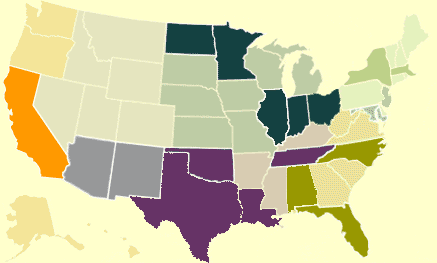
Below are the statewide percentages of residents in nursing homes who in 2005 had a psychological diagnosis other than dementia:

Alabama 24.5 Louisiana 27.5

Oklahoma

21.4
Alaska 18.7 Maine 16.6

Oregon

15.0
Arizona 14.7 Maryland 16.0 Pennsylvania
17.3
Arkansas 18.5 Massachusett 20.9 Rhode Island
14.5
California 19.2 Michigan 16.4 South Carolina 15.1
Colorado 14.9 Minnesota 18.9 South Dakota 23.6
Connecticut 13.2 Mississippi 26.3 Tennessee 23.0
Delaware 19.0 Missouri 20.3 Texas 23.4
D. C. 17.7 Montana 13.5 Utah 14.2
Florida 19.7 Nebraska 20.0 Vermont 13.8
Georgia 18.9 Nevada 16.3 Virginia 15.3
Hawaii 7.2 New Hampshire 19.5 Washington 15.3
Idaho 14.8 New Jersey 14.8 West Virginia 25.2
Illinois 23.6 New Mexico 17.0 Wisconsin 16.0
Indiana 17.6 New York 16.5 Wyoming 11.0
Iowa 17.3 North Carolina 15.4    
Kansas 22.0 North Dakota 19.7    
Kentucky 22.0 Ohio 28.8    

Special thanks to Charlene Harrington and her colleagues at University of California San Francisco.

Steve Gold, The Disability Odyssey continues

Back issues of other Information Bulletins are available online at http://www.stevegoldada.com with a searchable Archive at this site divided into different subjects. To contact Steve Gold directly, write to stevegoldada@cs.com or call 215-627-7100.

Transportation Disadvantaged:

Progress in Implementing the New Freedom Program Has Been Limited, and Better Monitoring Procedures Would Help Ensure Program Funds Are Used as Intended. GAO-07-999R, July 19. http://www.gao.gov/cgi-bin/getrpt?GAO-07-999R

EQUITY e-newsletter: Summer 2007 Creating Affordable, Accessible Housing Through Collaboration

Disability and Asset Building Communities Working Together
- http://www.wid.org/equity

Highlights of a GAO Forum: Modernizing Federal Disability Policy

http://www.gao.gov/cgi-bin/getrpt?GAO-07-934SP Highlights - http://www.gao.gov/highlights/d07934sphigh.pdf

Family Voices, Inc.
[fridayschildnews] Friday's Child: August 3, 2007

http://www.familyvoices.org/pub/fc/html/Friday's%20Child.htm.

AAPD Launches ADA Restoration Act Blog

What a last week it's been! Last Thursday, we celebrated the 17th Anniversary of the signing of the ADA. We were also celebrating the bipartisan introduction of the ADA Restoration Act of 2007 in both the House and the Senate. On the day of its introduction, we had already secured 143 co-sponsors in the House! Amazing! And today, just over a week later, we have 30 new co-sponsors in the House, bringing our total up to 173!

In an effort to bring you all the latest, share photos, and most importantly, engage you in the discussion as well, AAPD has launched an ADA Restoration Act blog at: http://adarestoration.blogspot.com. It's a work in progress we expect there will be kinks to work out along the way, so be patient with us - but we hope the blog can be the beginning of a more interactive approach to engage disability advocates across
the country.

The site has been enabled to receive comments (on a delay), so you're invited to leave your reactions to updates or provide your own updates on your efforts to secure additional co-sponsors from your home states and districts.

In addition, those interested can find links to the text of the legislation, Congressional press releases, news coverage, lists of cosponsors, and other background information. We'll continue to add additional resources to the site that advocates can use when making calls or educating their own local grassroots. Let us know what you need to be more effective and we'll figure out a way to get you the tools. Together, we'll see this law enacted and the original intent of Congress in passing the ADA restored!


Until Next week

The Arc of the United States,1010 Wayne Avenue, Ste. 650,Silver Spring, MD 20910, Phone: 301-565-3842, Fax: 301-565-3843, Email: mmwdc@info.thearc.org, Web: www.thearc.org

Disclaimer: MMWDC publishes information about issues and events that we believe to be important and likely to be of interest to advocates and others interested in inclusion of persons with disabilities in all parts of society.  However, MMWDC and The Arc of the United States and TheArcLink Incorporated do not necessarily endorse all events, sponsoring organizations and reports which appear.